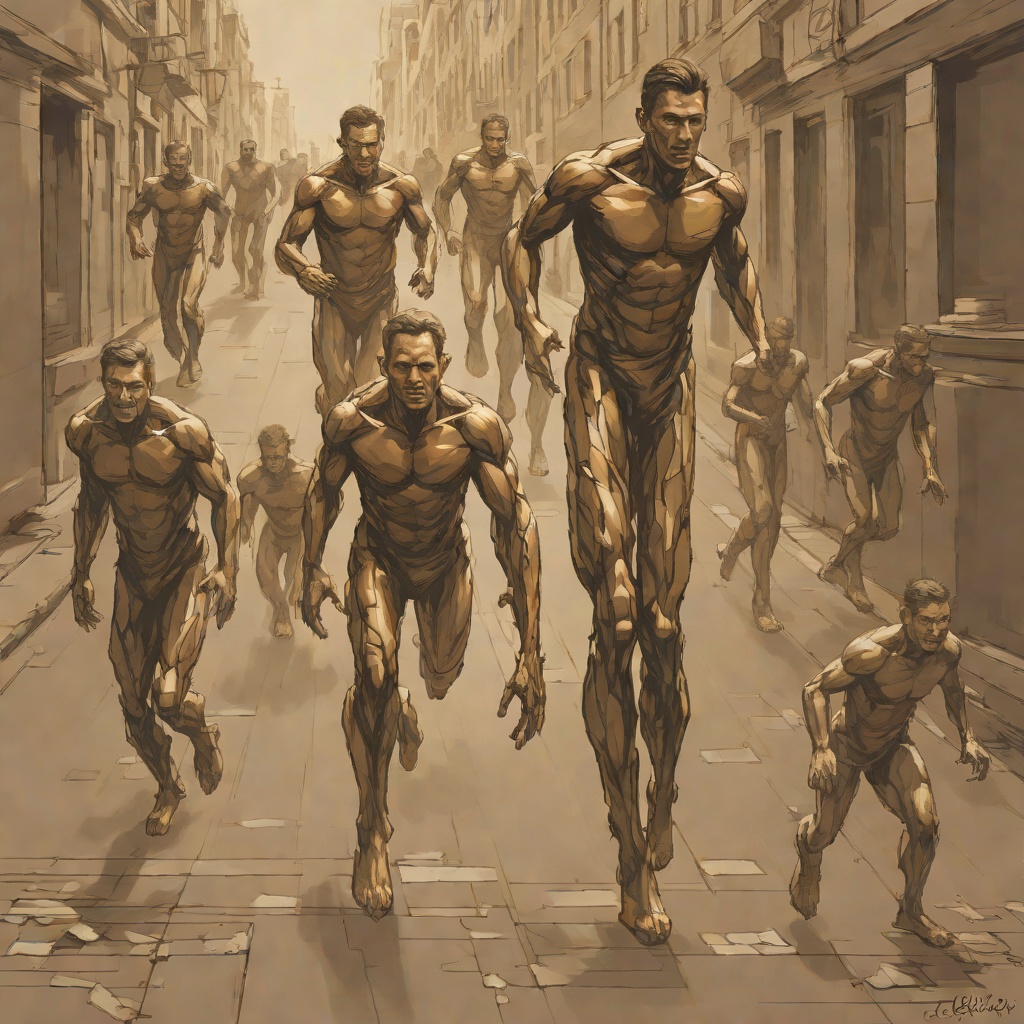
Manchester
The Running ManManchester occupies a crucial middle position in Ben Richards’s escape. It is not presented as a secure destination so much as a temporary shelter built from aliases, hidden transport, rented rooms, and the hope that a fugitive can remain unremarkable long enough to move again. Bradley Throckmorton’s plan gives Manchester practical importance, but the city’s deeper significance lies in the contrast between apparent refuge and institutional exposure: even distance, disguise, and careful routine remain vulnerable to the social machinery that turns poverty and dissent into objects of pursuit.
Manchester as a Planned Refuge
Manchester enters the escape plan through Bradley Throckmorton’s effort to move Ben Richards away from the immediate danger surrounding Boston. Bradley rejects Vermont as unsuitable because it lacks enough people sympathetic to their cause and has tough police, then proposes Manchester as a more workable destination. His arrangement depends on layered concealment: a driver will take a vehicle north and leave it in an automatic garage, while Bradley transports Richards separately, hidden in a trunk, along the back road and Route 495. Manchester is therefore not simply a place on a map; it is the endpoint of a carefully segmented route designed to prevent any single checkpoint from revealing the whole movement.
The plan also assigns Manchester a bureaucratic identity. Bradley reserves a room for Richards at the Winthrop House on Winthrop Street under the name Ogden Grassner. The name is part of a larger strategy in which survival depends on becoming administratively plausible rather than personally invisible. Richards understands that recognition is an immediate danger, while Bradley insists that the fugitive must behave like a chameleon and warns him not to drive out of Manchester without changing his disguise. The city’s safety thus rests on continual performance: a room reservation, a matching name, controlled conduct, and the readiness to abandon the identity as soon as it becomes unsafe.
The City in the Escape Network
Manchester is connected to an improvised communications system intended to evade the Games authorities. Bradley explains that Richards’s suitcase contains gummed mailing labels bearing a return address for Brickhill Manufacturing Company in Manchester, New Hampshire. The labels were produced with help from a press at the Stabbers’ headquarters on Boylston Street, and Richards is expected to send two tapes each day in a labeled box. Bradley will forward the material to Games from Boston by Speed Delivery, a method he believes the authorities will not decipher. Manchester therefore functions simultaneously as a hiding place and as a logistical fiction, supplying the respectable commercial identity through which illicit messages can travel.
The Winthrop House is a temporary node in that system rather than a permanent refuge. Bradley tells Richards that the reservation begins the following week and may or may not remain safe, advising him to judge the situation as it develops. A further address in the suitcase points toward a person in Portland, Maine, who may hide him for a day or two at a cost. The sequence makes Manchester one link in a chain of provisional shelters extending through New England. Its value lies in postponement: it buys time, but offers no final protection.
Poverty and the Urban Border
Manchester’s meaning becomes sharper against the urban geography Richards has crossed before the escape network carries him north. In Co-Op City, poverty is not merely an individual condition but a spatial order. The district south of the Canal is described as a radiating rat warren of parking lots, deserted shops, Urban Centers, and paved playgrounds, where cycle gangs exercise more authority than the police. The streets are ghostly and dangerous, and residents who venture out rely on pneumo buses or carry gas cylinders. Richards walks because his week’s twenty-dollar unemployment allotment, paid in oldbucks, is gone; he cannot afford a bus token.
The Canal marks a social and material boundary. South of it, stripped vehicles, broken lights, garbage, rats, graffiti, grilled liquor stores, smoke shops, and cycle gangs define a neglected landscape. Across the Canal, the city changes into a zone of expensive movie houses, ungrilled smoke shops, police on every corner, and controlled public leisure. The People’s Fountain Park charges admission and encloses children on astroturf behind chain-link fencing, with police at the gate. Above this divided city rises the Network Games Building, one hundred stories high and partly buried in cloud and smog. Richards crosses the Canal and approaches the building because, in the uptown order, a man with baggy gray pants, a cheap bowl haircut, and sunken eyes has only one recognized function: the Games.
This geography explains why Manchester can appear attractive without becoming genuinely free. Movement is regulated by money, transport, policing, and social legibility. The fugitive does not escape the system by leaving one neighborhood; he passes between zones whose different surfaces conceal a shared structure of exclusion. Manchester’s role in the plan depends on exploiting that structure, using a commercial address and a rented room to make flight look like ordinary business travel.
A Temporary Life Under an Alias
Richards’s Manchester identity is prepared through a sequence of disguises. After leaving Molie’s at ten past midnight, he is twelve hundred New Dollars poorer but equipped with gray hair, spectacles, mouth wadding, plastic buck-teeth, and instructions to adopt a slight limp. His wallet cards identify him as John Griffen Springer, a forty-three-year-old widower and text-tape salesman from Harding. The disguise is deliberately limited: he has no technico status, but that absence is considered useful because technicos possess a distinct language that might expose an impostor.
The identity under which Richards reaches Manchester is not the same as every name used along the escape. At the Boston Y.M.C.A., he signs the register as John Deegan from Michigan, while later instructions place him in the Winthrop House under Ogden Grassner. These changes show that Manchester is embedded in a constantly shifting chain of false records. Each alias is less a stable character than a disposable credential, and each hotel or address becomes a test of whether the credential can survive contact with clerks, staff, police, and neighbors.
The hotel routine transforms concealment into a form of disciplined theater. Richards is told to remain within the role, and the account of his stay emphasizes how well he performs it: he eats dinner in his room, rises at seven, reads his Bible in the lobby, and goes out to a supposed meeting. The hotel staff treat him with contemptuous cordiality reserved for fumbling clerics who pay their bills. That response is important because it shows the disguise working through social prejudice. He is not protected by acceptance; he is overlooked because others place him inside a familiar, diminished category.
From Shelter to Exposure
Manchester’s refuge remains precarious because the surrounding world is governed by surveillance and force. The narrative repeatedly associates the fugitive’s movement with police scrutiny, false papers, and the danger of being identified as a person outside the permitted social order. Even the larger escape route eventually converges on a militarized threshold at Voigt Airfield, where police hold back employees and passengers, an A-62 tank blocks the main gate, and a control tower dominates the terminal complex. That later setting reveals the scale of the system against which the Manchester arrangement has been operating: a rented room and mailing label are fragile tools beside armed checkpoints, aircraft control, and the Network’s institutional reach.
The city also belongs to the same ideological environment that marks Richards as a threat. The Network calculates ruthlessly around people who do not fit its present order, treating a person who seems like a throwback, an embarrassment, or perhaps a danger as a small particle around which larger clouds of repression can condense. At the Boston Y.M.C.A., a clerk’s casual racism demonstrates how official and popular hostility reinforce one another: the clerk imagines segregating Black children while assuming that social contempt is common sense. Such encounters establish the atmosphere in which Richards must move. Manchester may offer a room, but it cannot suspend the categories—unemployed, suspect, outsider, criminal—through which institutions and ordinary citizens make him visible.
Narrative Significance
Manchester is significant as a produced space of escape rather than a neutral setting. Its safety is assembled from transport infrastructure, commercial addresses, postal routines, hotel etiquette, regional distances, and the uneven distribution of police attention. The same modern systems that enable movement also enable control. A mailing label can conceal a tape; a hotel register can authorize a room; a road can carry a fugitive north; yet each system leaves records and creates points at which an identity may fail.
The location also exposes the paradox of Richards’s flight. He needs the social order to ignore him, but the order ignores only those it has already classified. His false clerical presentation succeeds because the hotel staff see a harmless, marginal figure, while the larger political system sees a dangerous deviation. Manchester consequently becomes a threshold between the impoverished southern city and the increasingly organized pursuit beyond it. It offers neither liberation nor belonging. It is a temporary interval in which Richards can send messages, preserve a manufactured identity, and wait for the next move while the machinery of the Games continues to define the terms of his existence.